Case study · Fintech · Self-service · Greenfield enterprise portal · Australian financial advisory firm · 2024
Self-Service Wizard
A wizard for clients who cannot name the service they need. Research kept surfacing the same client sentence: “I need financial help, but I don’t know what financial service I need.” So I designed a 7-question guided assessment that translates how clients describe their lives into the services the firm sells, ending in tailored bundles and a checkout that holds back the one thing a business usually wants first: payment. No charge happens until an adviser has reviewed the request, and that tradeoff cost the firm the self-serve conversion it would rather have had.
North Star was the name we gave the vision of digital service delivery to a client base of more than 250,000, and three sub-features carried it. Portal onboarding was designed to replace branch-mediated sign-up and a payments flow to bring invoicing in, but the Wizard had to reach further than either, because it was the only one of the three standing in for a judgement an adviser would otherwise have made: it took the routine requests that were arriving as staff-attended back-office tasks and handed them to clients in a form they could start and finish alone.
All interfaces below are recreations built for this case study. Branding & details changed; no client IP shown.
At a glance
- The problem
- Clients could not name the service they needed, and the discovery conversation that fixes that is the most expensive part of an advisory firm’s sales motion.
- What I did
- Owned a 7-question guided assessment end to end: the question design, the logic that turns answers into a recommendation, and a checkout that takes no payment until an adviser has reviewed the request.
- What it produced
- One of four prototypes in the board pack for the build-versus-extend decision. Never user-tested, which is the honest limitation and is written up in full below.
myPrtalPersonal
Home Services MeetingsManaging My Wealth
Review our recommended service bundles below, designed to help you manage your wealth.
Standard Wealth
For getting started- Complimentary discovery meeting
- 3 virtual check-ins per year
- Adviser help 9am-1pm
- Retirement & pension advice
Premium Wealth
For active oversight- Unlimited in-person check-ins
- Adviser help 9am-5:30pm
- Super & investment advice
- Personal insurance
- Monthly portfolio reviews
Comprehensive Wealth
For full-service planning- 3 in-person check-ins per year
- Adviser help 9am-3pm
- Retirement & pension advice
- Personal insurance
Where the Wizard lands: service bundles in the client’s language, not the firm’s. Recreation; no client IP.
The Problem
A financial advisory firm was building a new client portal, and the service catalogue inside it had a language problem. The firm sells things called Asset Allocation Advice and Income Protection Insurance. Clients arrive thinking about a wedding, a first home, a business they want to start. Nobody wakes up wanting income protection insurance. They want to know their family is fine if something happens to them.
The same client sentence turned up again and again in our research, close to word for word, and it is the whole reason this exists.
I need financial help, but I don’t know what financial service I need.
Recurring client quote, client research
Asking a client like that to browse a catalogue is asking them to translate their own life into the firm’s product names, and they will not do it.
The Wizard is not there to assess anyone. It is there to translate, in one direction, from how people describe their lives into the services the firm actually sells.
Service catalogue
- Asset Allocation Advice
- Income Protection Insurance
- Superannuation Consolidation
- Estate & Succession Planning
- Debt Structuring Review
- Trust Establishment Services
What are you trying to do?
- Make sure my family is fine without me
- Buy a first home in the next two years
- Stop paying fees on four old super accounts
- Leave things tidy for my children
- Get on top of the mortgage and the car loan
- Set up something for the grandchildren
Drag the handle to the right. Same six services, twice: what the catalogue called them, and what clients called them in research. The Wizard is the mapping between the two.
Underneath the language problem sits a commercial one, and it is what makes this worth building. Winning advisory work is one of the most expensive sales motions in any industry, while the cheapest growth a firm can get is already sitting in its client base.
US$3,119
Average cost of acquiring one client, across nearly 1,000 advisers. 83% of it is the adviser’s own time, not marketing spend.
1-5%
Conversion rate on purchased leads, which is the alternative way firms try to buy growth.
79% / 48%
Buyers who want more services from their current provider, versus those who do not know what that provider offers.
Sources: Kitces Research (adviser economics); Hinge Research Institute (professional-services buyers). Published industry research used to size the problem, not results measured on this project.
That is not a demand problem, it is a discovery problem, and a self-service wizard exists to close exactly that gap, by letting clients scope their own needs in minutes of their time instead of hours of a fee-earner’s.
The Approach
My role & ownership
I led the research synthesis for the firm’s client portal programme. The Wizard was a piece I owned end to end: the question design, the logic that turns answers into a recommendation, the recommendation surface itself, and the checkout pattern at the end. The premise came straight out of the research I had just spent weeks pulling together, so I was designing from something I already understood rather than a brief handed to me.
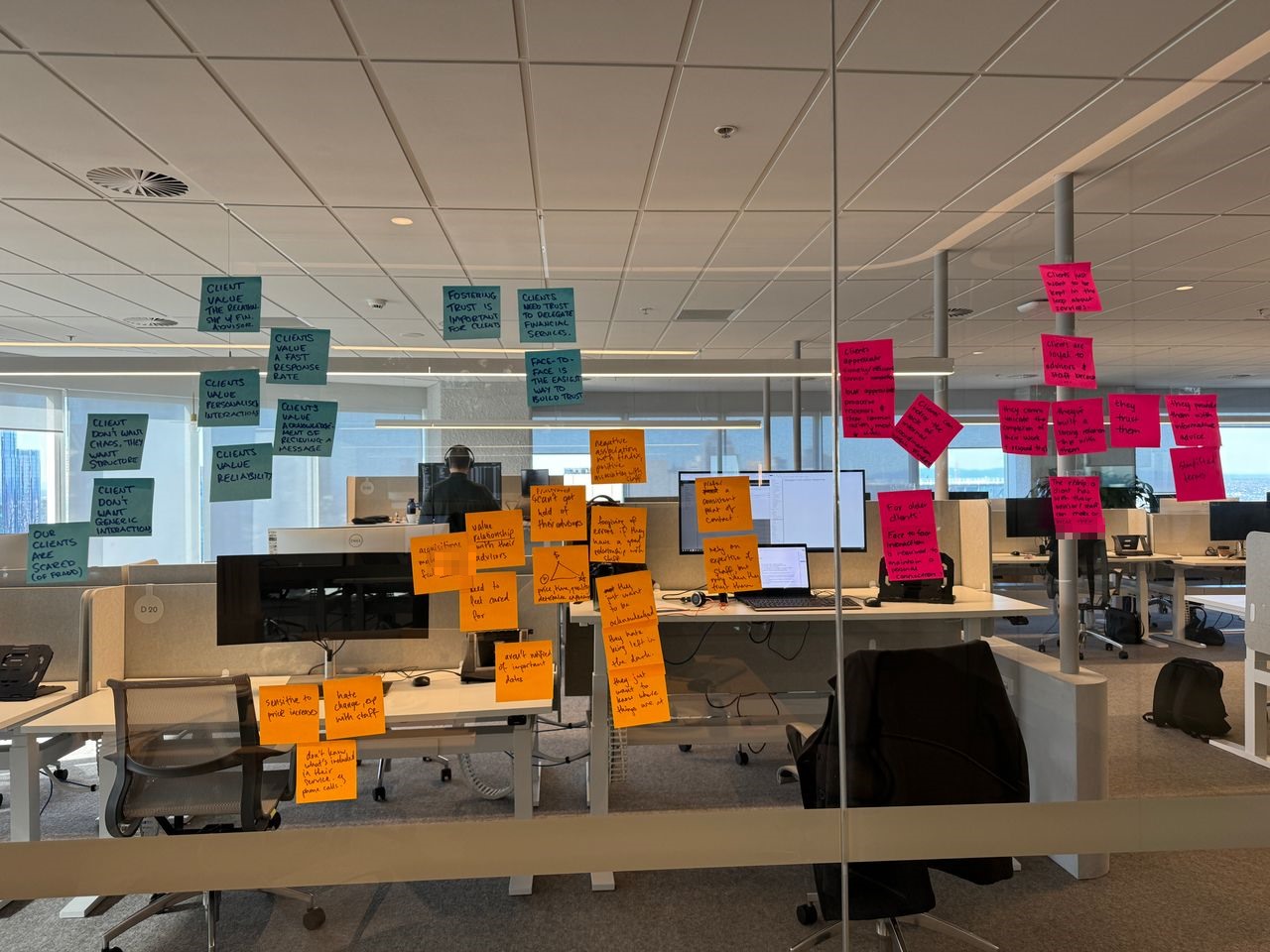
A note on platform
The Wizard is a desktop-first experience. It is the kind of considered sit-down a client does at a laptop, not something you tap out at a bus stop, so it is designed for that context. The companion onboarding flow was the opposite, designed mobile-first, and it is its own case study.
Try it: the live prototype
Everything this case study argues, you can test yourself below: the honest opt-out, the “I’m not sure” escape hatch on every question, the validation, the real loading copy, and a checkout that ends at Pay today: $0.00. It is fully keyboard-operable, and if several answers are “not sure” the recommendation deliberately softens rather than pretending to certainty. Rebuilt with synthetic content for this case study; no client IP.
Live prototype, keyboard operable throughout. Use the demo shortcuts at the bottom of the frame to jump straight to the results, the partial-data state, or the confirmation. Open full screen ↗
Entity first, then an honest opt-out
Before any questions arrive, the client says who the service is for, whether that is themselves, a business or a trust, and that one answer routes everything downstream, because a personal recommendation is wasted on a small-business owner and a business one is wasted on someone asking for themselves.
With the entity locked in, the Wizard offers a genuine choice. Skip, I know what services I want routes straight to the Service Catalogue. Begin, I don’t know what services I want starts the assessment. Both read equal in weight, but the default emphasis sits on Begin, because the research said most clients arriving here would be in the second group, unable to name what they needed.
myPrtalPersonal
Home Services MeetingsService Wizard
Let’s find the services that fit your life
Welcome to the Service Wizard, a short, personalised assessment designed to suggest the services most suitable for your selected entity. Your answers are private, and you can save them or re-enter them later.
Selected entity
Save these results for next time
Entry · entity selection, then the honest opt-out. Recreation.
Seven questions, and why each is there
Every question is paired with an I’m not sure option, so false-positive answers don’t pollute the recommendation. I wrote every question in life-language, not product-language.
myPrtalPersonal
Home Services MeetingsWhat are your short-term financial goals?
Select all that apply. If you’re unsure, simply select ‘I’m not sure.’
Q1 · goals in life-language, with the ‘I’m not sure’ escape hatch first. Recreation.
myPrtalPersonal
Home Services MeetingsDo you anticipate any significant changes to your income in the next 5 years?
Select one option, inclusive of superannuation. If you’re unsure, simply select ‘I’m not sure.’
Q5 · single-select cards for the income outlook. Recreation.
Why seven
Seven is not a number I optimised to. It is the number the output needed. The Wizard has to place a client into one of four goal groups and one of three service tiers, and every question earns its place by feeding that. Goals, short and long term, map the groups. Commitments, income, and expected income change calibrate the tier, so the recommendation is realistic rather than aspirational. Retirement age sets the horizon, and the final question about their biggest concern re-weights the top result toward whatever they actually lose sleep over. Take any one of those away and the recommendation gets worse in a way you can point to.
I want to be honest about the tension though, because it matters here. Completion drops with every question you add, and the worst of that drop sits in the middle stretch of a form rather than at either end. Seven sits at the very top of what I would consider defensible. It survives because this is not a survey a client fills in for us, it is a tool that only works if it has enough to go on, and below seven the recommendation stops being specific enough to trust. If I could change one thing about the design, it would be to stop asking all seven of everyone, which is the next section.
The output: bundles in human language
While the recommendation is generated, the loading state says what is actually happening: “Generating service recommendations for you…”. Then the surface deliberately swaps the firm’s internal jargon for goal-language at the top level. Managing My Wealth, Preparing for a Rainy Day, Saving for a Home, Consolidating Debt. Technical service names sit one click deeper, so the client sees what they’re working towards and the adviser still sees what they’re delivering.
Within each goal, the client picks a tier, and I put the middle one forward by default: it is the tier advisers most often point clients toward, and the one I designed the flow to make the natural landing point for someone who has not decided already.
myPrtalPersonal
Home Services MeetingsManaging My Wealth
Review our recommended service bundles below, designed to help you manage your wealth.
Standard Wealth
For getting started- Complimentary discovery meeting
- 3 virtual check-ins per year
- Adviser help 9am-1pm
- Retirement & pension advice
- Superannuation advice
Premium Wealth
For active oversight- Unlimited in-person check-ins
- Adviser help 9am-5:30pm
- Retirement & pension advice
- Super & investment advice
- Personal insurance
- Monthly portfolio reviews
Comprehensive Wealth
For full-service planning- 3 in-person check-ins per year
- Adviser help 9am-3pm
- Retirement & pension advice
- Superannuation advice
- Personal insurance
Recommendations · three tiers per goal, middle tier forward, add-on catalogue below the fold. Recreation.
The checkout: familiar pattern, one critical change
The flow mirrors a pattern clients already know. Add to Service Bag, Review, Confirm. The one deliberate difference is the commitment. No charge happens until an adviser has reviewed and approved the service. Financial advice is not a jumper you buy at midnight, and pretending it is would have broken the trust the whole portal was trying to build. So the checkout gives clients the closure of a familiar pattern, the bag, the review, the confirmation, while keeping a human in the loop before any money moves. You get the ease without the firm having to pretend advice is a self-serve product.
Browse or recommend
Wizard results, or the full Service Catalogue if skipped.
Review details
Service summary, pre-filled billing, required documents.
Service bag
Review everything selected before submitting.
Confirm
Billing verified. Card on file. Pay today: $0.00.
Pending review
Adviser reviews. Client gets confirmation when service starts.
Phase 1, then Phase 2
If the portal had gone ahead, I sequenced it as two phases rather than one launch. Phase 1 would ship as an Expression of Interest flow: same shape as a checkout, but the submission queues for adviser review before any charge. Phase 2 would open self-service purchase for the services that don’t need adviser input at all. Neither phase shipped, since the engagement ended at the decision this prototype was built to inform, but I designed the flow so Phase 2 would be a downstream toggle, not a rebuild.
The Outcome
The Wizard was one of four prototype explorations that went to executives and the board, as part of the strategy for whether to build a new portal or extend the existing one. Its job in that deck was to make an abstract argument concrete. It is one thing to say clients cannot navigate a catalogue of financial jargon, and another to show a working flow that takes someone from “I don’t know what I need” to a short list of services described in their own language. It also had to survive a harder question in that room: whether a self-service flow could be trusted with money at all, which is why the checkout it showed never took payment until an adviser had reviewed the request.
What the Wizard put in front of the board was concrete: a flow where someone who cannot name a single product on the firm’s list still reaches the right bundle in seven questions, without an adviser having to run the discovery conversation to get them there.
I will be as straight here as I have been everywhere else: there is no conversion number, because the portal was a strategy and design engagement rather than a shipped product. For a piece of work whose point was to change how the firm thinks about selling services, that was the job.
The commercial case follows from the economics in the problem, and I will label it as what it is: the business case the prototype argues, not a measured result. Every client who scopes their own needs through the Wizard replaces the most expensive part of the firm’s sales motion, which is fee-earner discovery time. And every bundle surfaced in goal-language reaches the half of clients who never knew the firm offered the service at all. Partially automating that conversation is where the savings live, and it is why this prototype earned a place in front of the board.
What didn’t work
The honest limitation is that I never watched a single client use this. The portal work was a strategy and design engagement that produced direction and prototypes for a decision, not a shipped product, so the Wizard was designed carefully and validated by nobody. For a flow whose entire value is the quality of one recommendation, that is the thing I most wish had gone differently. Everything I believe about it is a well-reasoned bet, not a tested fact, and I would say that in the room.
Testing would have caught the flaw I can already see in it. Every client answers all seven questions, whether they are relevant or not. Someone who has just told me they are starting a business is still asked what age they plan to retire. Given what the research says about every extra question costing completions, a flow that cannot skip its own irrelevant questions is leaving completions on the table by design. The right version is adaptive: each answer decides which question is worth asking next, so nobody is walked through steps that do not apply to them. I designed the static version because it was what the prototype needed to demonstrate the idea. The tested version would have had to be smarter.
Reflection
The most useful skill on this was not visual design. It was translation. Not the wizard’s translation of clients into services, though that was the point of it, but my own, between a firm that describes what it does in product and compliance language and a client base that describes its life in weddings and houses and worry. Most of the good decisions here came from refusing to let the firm’s language win by default, because the client never speaks it.
The other thing I take from it is smaller and more personal. I am confident designing a flow like this and I can defend every question in it. I am less practised at insisting the thing gets tested before I call it finished, and this is a flow that needed it. That is the gap I would most like to close next.